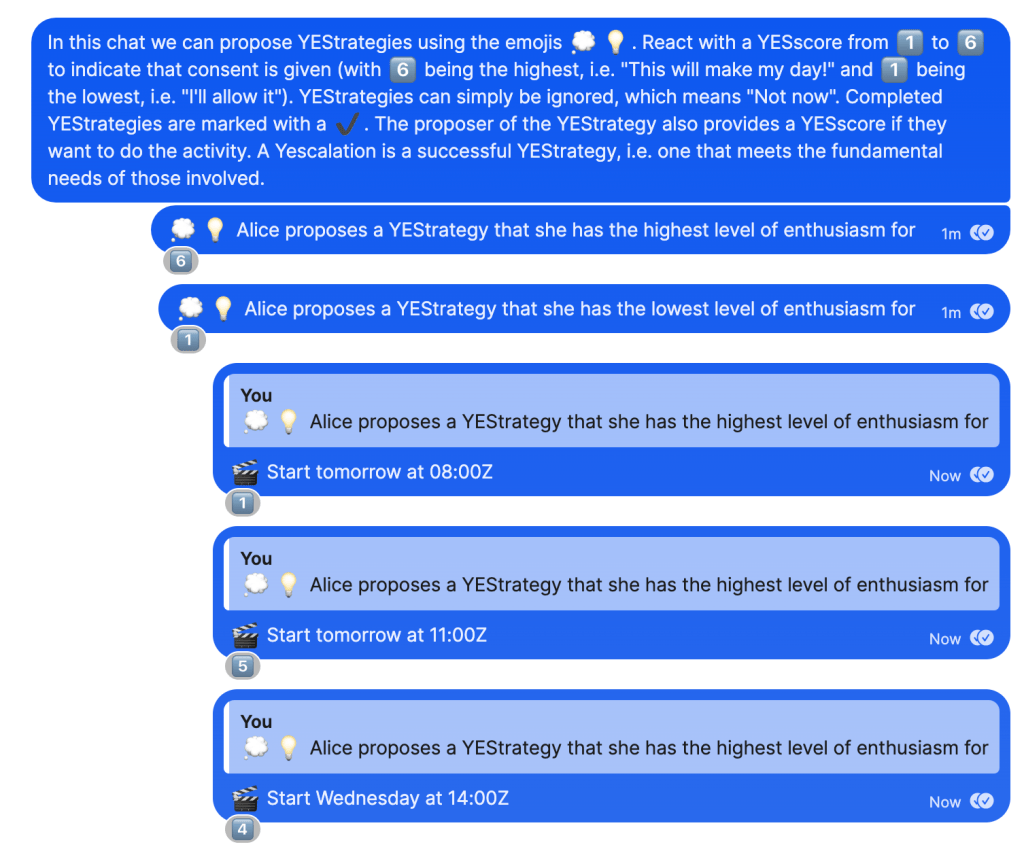
I wrote about the concept of a YEStrategy in this previous blog post and now I want to add to this with some handy tips for using this tool in the digital realm, including on messaging apps such as Signal, WhatsApp and Microsoft Teams.
In this post, I’ll start by summarising the digital instructions and include some additional tips for using YEStrategies and YESscores. Then I’ll describe some interpretations of the YESscores. Next I’ll describe a brief wishlist for additional features in the messaging apps to help facilitate these tools more effectively. Finally I’ll describe some additional tools that can be used in conjunction with YEStrategies. FYI this toolset is known as the language of Yesperanto – an ever-evolving language designed to meet fundamental human needs.
Digital YEStrategy Instructions
Here are the instructions for proposing a YEStrategy on a digital messaging app, with some extra tips:
- YEStrategies are proposed with the thought bubble and lightbulb emoji symbol combination 💭💡, which are chosen to reflect the fact that a YEStrategy is a special kind of idea.
- YEStrategies are written in the third person present tense, rather than the imperative (commanding) form (e.g. “💭💡 Alice does a workout” rather than “💭💡 Do a workout”). This is to emphasise the underlying value system of Yesperanto which prioritises creating a nurturing environment where everyone’s needs matter, having multiple options to choose from, finding activities that we share a high level of enthusiastic consent for, and letting go of attachments to any one specific strategy.1
- Each YEStrategy is proposed in a separate chat message. This is so that it is possible to ‘react’ to each one with a separate YESscore.
- If you consent to doing the YEStrategy, you can react to it with a YESscore indicating your level of enthusiasm from 1️⃣ to 6️⃣, where 6️⃣ is the highest priority (i.e. “This will make my day!”) and 1️⃣ is the lowest priority (i.e. “OK, I’ll allow it.”) Remember that, in order for a YEStrategy to be consensual, everyone who it applies to must react with a YESscore of 1️⃣ or above. It’s important to note that the proposer of the YEStrategy does not automatically consent to it. In fact, it’s even encouraged to propose YEStrategies that you don’t want sometimes, since this can help the creative process and broaden horizons. Note also that since consent is reversible (as per the FIRES or FRIES model of consent, i.e. Freely given, Informed, Reversible, Enthusiastic and Specific), a YESscore reaction can be updated or removed at any time.
- If you have seen the YEStrategy, there is no obligation to respond to it because no response simply means “Not now”. However, it can be useful for the others involved to know you have seen it or are still considering it, so an eyes emoji 👀 or thinking emoji 🤔 can be a helpful reaction. It’s also possible, but not necessary, to respond with a 0️⃣.
- Anyone can react to a completed YEStrategy with a ✔️ to indicate “The thing has been done!”
- It is helpful to propose additional details, such as the date and/or time to start the YEStrategy, or the location, by replying directly to the original YEStrategy message. This keeps things nice and tidy, and allows for more optionality e.g. multiple possible dates/times or locations. You can respond using the action 🎬 emoji and then write a start time (e.g. “🎬 Start tomorrow at 11:00Z”, “🎬 Start 1st January at 8:00Z” etc.) and a pin📍emoji with the location (e.g. “📍 At the Eiffel Tower”, “📍 In my living room” etc.). This also gives the other people involved an opportunity to propose alternative details.
- As an additional option, you can respond to a YEStrategy with the pomodoro / tomato emoji 🍅 to suggest a pomodoro session2 focused on doing the task, with the length of time in minutes (e.g. “🍅 x 1 for 25 mins”) and a start time (e.g. “🎬 Start now”). This can be helpful to gain motivation and focus when co-working.
- The bridge emoji reaction 🌉 can be used in a response to a specific YEStrategy to say “I’m potentially interested but I’m not ready. Please can we propose some bridging YEStrategies to help make this more approachable?” For example, if I react with a 🌉 to “💭💡 Alice runs a marathon” this might prompt a conversation about what YEStrategies would help me to get to a point where I can (enthusiastically) consent to it. An example here could be “💭💡 Alice goes for a 5km run”. This helps break a task down into smaller more manageable steps and to expand my comfort zone.
Interpreting YESscores
Note that YESscores can be interpreted in different ways. One way to interpret them could be the following:
- 4️⃣-6️⃣: “I think this benefits me/us directly – I consent with low/medium/high priority, respectively.”
- 1️⃣-3️⃣: “I think this benefits you primarily – I consent with low/medium/high priority, respectively.”
- No score (or 👀, 🤔, or 0️⃣): “Not now.”
This adds clarity in that it allows each person to say:
- Whether they consent to the proposal, in theory.
- Who they think the YEStrategy is primarily for (i.e. who benefits?), as per Betty Martin’s Wheel of Consent. This helps to avoid the situation where no-one thinks they are directly benefiting!
- What is their priority / enthusiasm level for the idea.
Using the scores in the way above can be very handy in terms of extra context, but it does also require some additional thought and might not always be applicable, so another option is to simply use the scores 1️⃣ to 6️⃣ to indicate relative levels of priority.
Future Digital YEStrategy Wishlist
In the future, I would love it if there was an app (or an add-on to an existing messaging app, such as a Signal fork) where YEStrategies and YESscores, and the standard emojis that go with them, are easily accessible and integrated. In such an app I would like additional functionality including:
- The ability to select which people are required to consent for the YEStrategy to go ahead, and indicate whether or not everyone has consented. Ideally it would be possible to view a YESummary, or a table of metadata about YESscores, for each YEStrategy to check who has and has not consented. Awareness of the latter group is particularly important because the aim is to ensure that everyone has an opportunity to voice what needs they have that may not be met by the strategy proposed, i.e. to help facilitating the creation of a nurturing culture where everyone’s needs matter. This is the basis of inclusive decision making.
- The ability to enable blind YESscores, so that you do not see the other people’s scores until you yourself have provided a YESscore or decided to respond “Not now”. This is because we are social beings and tend to be influenced by each other’s enthusiasm level, so a blind option can help us to tune in to our inner compass. After seeing the other people’s scores, we may wish to adjust our original score but it is recommended to leave it as is and then react with a “relational” score on the date/time start 🎬 message instead (unless you have gathered more information about the YEStrategy which enables you to see its inherent value for you more clearly). The relational YESscore takes into account everyone else’s YESscores for the YEStrategy, as well as all of the other YEStrategy options currently available and the person’s own capacity (e.g. energy levels).
- The ability to calculate the average YESscore for each YEStrategy, and allow for various ordering and filtering options, e.g. rank YEStrategies by the highest average YESscore to the lowest (possibly within a given date range), only show YEStrategies where everyone has given a score of 4️⃣ or more etc. This would be particularly helpful for co-created gatherings where there are larger numbers of people involved, so more calculations needed.
Additional Digital Communication Tools
In addition to YEStrategies, there are a number of additional digital communication tools that I have been trialling recently:
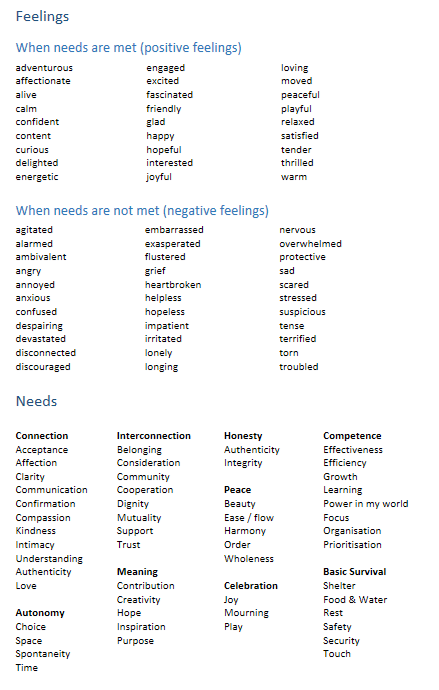
- Nonviolent communication (NVC) check-ins. To do a check-in digitally, share your feelings and your highest priority unmet fundamental needs as a message in the chat (e.g. using the reference guide below). A check-in is recommended prior to coming up with YEStrategies because it helps to foster empathy and to define the problem that you are trying to solve, i.e. the unmet needs. For example, “Feeling: calm, grounded, optimistic, hopeful, focused, a little restless. Needs: connection, effectiveness, inspiration, playfulness, creativity, organisation”.3
- Use the emoji combination “🚦🫵?” (traffic-light, index-pointing-at-the-viewer and a question mark) in a message to mean “What’s your traff?” (short for “What’s your traffic light status?”) to ask everyone in the chat to communicate how they are feeling in this moment, i.e. their overall status. Each person can ‘react’ to this message with a coloured circle, according to the code below:
- 🔵 – “Blue: This is wonderful, more of this please!” 😍
- 🟢 – “Green: All good, let’s keep going!” 😃
- 🟠 – “Orange: I’m feeling a little bit uncomfortable, can we have a check-in?” 🥲
- 🔴 – “Red: I’m having a bad time and want this to stop immediately.” 😭
- Another option is to use fruit emojis to indicate the different traffic light colours, e.g. 🫐, 🍏, 🍊 and 🍎. An additional colour, “Pink” (e.g. 🍉), can be used to mean “My social battery has expired and I’m entering a period of silence to recharge.” Note that there is not currently a pink circle available on most messaging apps, but this could be added in future. Alternatively, the low battery 🪫 emoji can be used for a similar purpose.
- Use the dotted-line-face emoji 🫥 to indicate a “disappeariod”. This is a period of time where the sender will “disappear” or be non-responsive for a while until the date/time specified (except in the case of urgent information needed / an emergency). For example, “🫥 2025-01-01 08:00Z” indicates that the sender will be having a disappeariod until the 1st January 2025, at 8am GMT. The aim of this is to give each person the option to have some space from the other(s) without the obligation to explain the context. This doesn’t necessarily mean that they will leave the physical space e.g. similar to the principle of ‘noble silence’ on a silent retreat. The signal for if one wants to come out of a disappeariod early is posting the face-in-clouds 😶🌫️ emoji.
Feedback…
I am always interested to hear if others are using these tools and how they find them. If you have any feedback or suggestions, please do send them my way!
- For more on the topic of ‘letting go’, see my comparison of Nonviolent Communication (NVC) and Buddhism here – note that I see YEStrategies and YESscores as a kind of add-on to NVC (i.e. NVC+). ↩︎
- A pomodoro session is a time management method, often based on 25-minute stretches of focused work broken by five-minute breaks. ↩︎
- I’m not aware of there being a specific emoji for feelings and needs, so please do drop me a message if you think of something! ↩︎
 Mindful Alice.